Exploring Liquid-liquid Phase Separation (LLPS) Dynamics in Peptide Systems
Living cells remarkably organize their complex biochemical reactions by creating compartments for chemical reactions to take place. These so-called membraneless organelles are a direct result of macromolecular liquid-liquid phase separation (LLPS) driven by intrinsically disordered proteins (IDPs) through multivalent weak interactions by their flexible and low-complexity amino acid regions.
The lab’s research is centered on exploring how the composition of peptide sequences influences phase transitions in the formation of membraneless organelles, as well as understanding the subsequent effects of such compartmentalization on the efficiency of chemical reactions, networks, and emergent behaviors, by using a simple and peptide-based approach.
1. Fundamental principles behind the formation of membraneless organelles LLPS, utilizing peptides as model systems
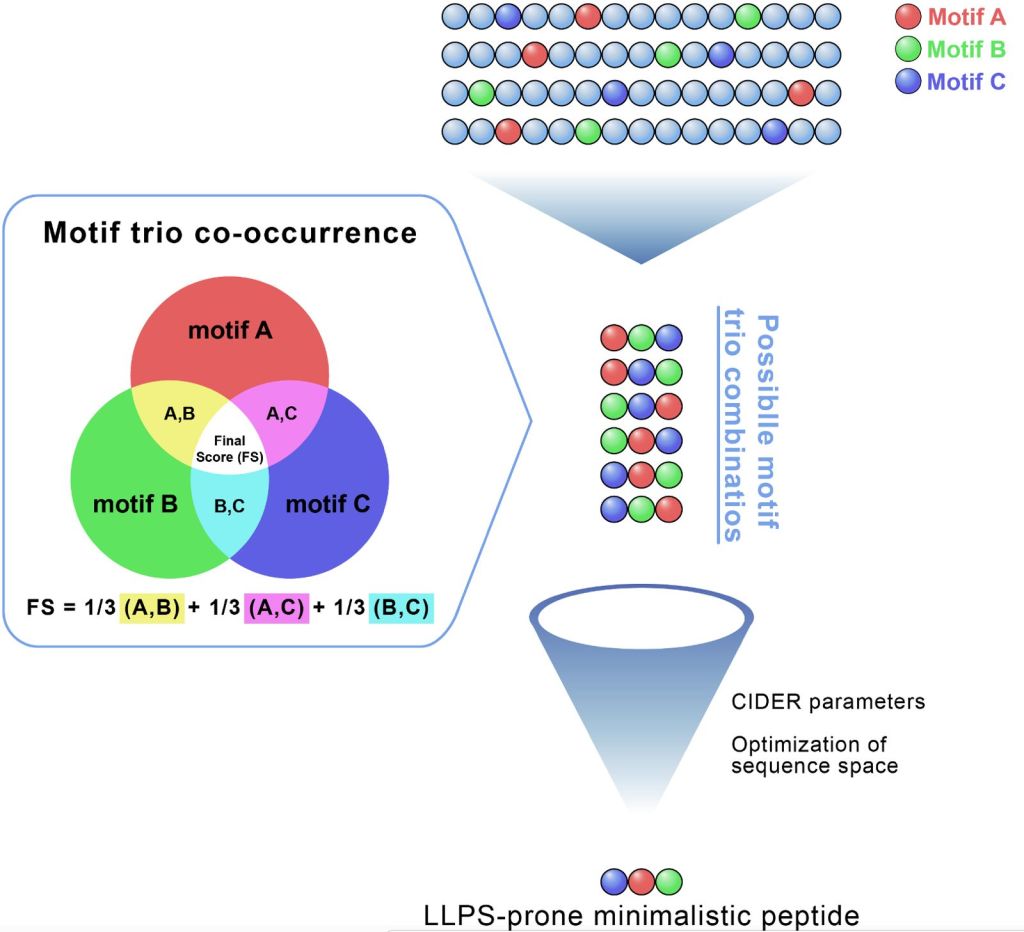
Our lab investigates the fundamental principles of membraneless organelle formation through a data-driven approach by identifying peptide motifs driving LLPS across diverse protein classes, going beyond the typical focus on prion-like RNA binding proteins. Our research not only provides insights into cellular organization but also has implications for designing artificial cells with programmable complexity and potential applications across different areas (medicine, diagnostics, environment).
2. Adaptive Catalytic Systems: From rigid templates to flexible architectures
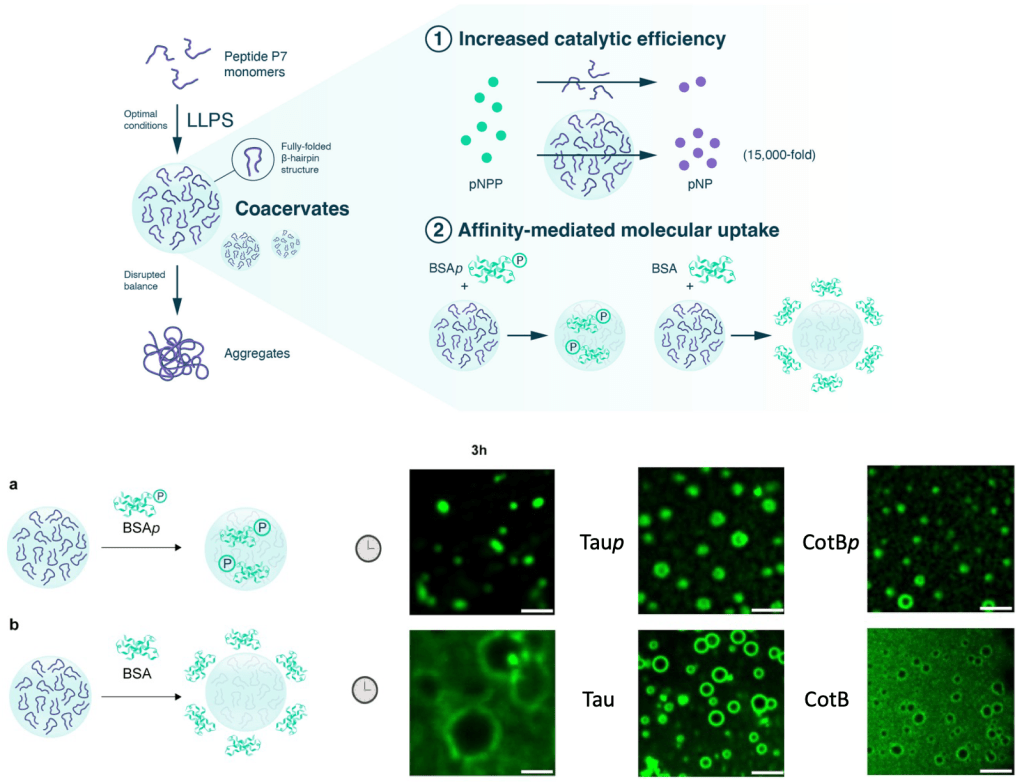
Nature has optimized enzyme designs that use LLPS to enhance catalytic efficiency. Our lab challenges conventional design methods by embracing the inherent flexibility and disorder of peptides. By placing controlled disorder and LLPS at the core of our peptide catalyst design, we aim to replicate the intricate functionality of living cells, as protocells mimetics, and to elucidate the emergence of life-like complexity from simple molecular systems, and ultimately to unlock new frontiers in sustainable catalysis and synthetic biology.

 Bioinspired Peptide Systems Lab