
Team leader

Ana Pina has dedicated her career to unlocking the potential of remarkable molecules such as Peptides to understand and mimic the precision, chemical efficiency and structural organization complexity found in Biology.
Ana Pina leads the Bioinspired Peptide Systems lab at Instituto de Tecnologia Química e Biológica António Xavier from Nova University of Lisbon. Her research explores supramolecular peptide systems with chemical biology tools to develop functional materials and peptide-driven protocell mimics, inspired by biological structures. Ana completed the PhD in Biotechnology (2013) from NOVA and University of Cambridge, with Prof. Cecilia Roque and Prof. Chris Lowe. Her PhD also included a visiting position at Scripps Research Institute. After postdoctoral work between NOVA and City University of New York, working with Prof. Rein Ulijn she established her research group at ITQB-NOVA (2021).
Suman Nayak
Suman Nayak obtained his B.Sc. and M.Sc. degrees in Chemistry from Jhargram Raj College and Vidyasagar University, India. He received his Ph.D. in Chemistry in 2023 from the Indian Institute of Technology (IIT), Patna under the supervision of Prof. Prolay Das. Suman’s doctoral research focused on designing and fabricating functional biomaterial, such as hydrogels and DNA condensates, and developing nanosensors based on fluorescent carbon nanomaterials for biomedical applications. After completing his Ph.D., he joined Prof. Subinoy Rana’s group at the Indian Institute of Science (IISc), Bangalore, as a National Postdoctoral Fellow (NPDF), where he explored the synthesis of single-substrate-based LLPS systems and the design of hierarchical coacervate morphologies, including core-shell, dumbbell, and Janus structures. Currently, Suman is a Postdoctoral Fellow in Dr. Ana Pina’s group at ITQB-NOVA, Portugal, where his research focuses on employing peptite-based coacervates for catalysis and molecular recognition in biomedical applications. He is also interested in the development of photo-catalytically active, intrinsically fluorescent coacervates that function as efficient microreactors for reactive oxygen species-mediated photocatalysis.

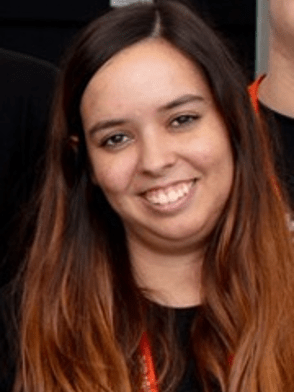
Joana Calvário
Joana Calvário holds a Bachelor’s in biochemistry and a Master’s in biotechnology from NOVA School of Science and Technology, and her academic journey reflects an enduring curiosity about fundamental processes underlying biological systems. Her research journey has been diverse, encompassing the use of bioinformatics in protein stability studies, the investigation of catalytic mechanisms of enzymes through transient kinetic assays, and the enhancement of electronic nose biosensors using Odorant Binding Proteins.
Joana now focuses her Ph.D. on understanding liquid-liquid phase separation (LLPS) in membraneless organelles, where she aims to unravel the molecular principles governing LLPS. Her research aims to create artificial functional compartments inspired by natural systems, shedding light on compartmentalization’s impact on the origin of proteins’ functions and enzymatic activity evolution. Joana’s ultimate goal is to make significant contributions to understanding LLPS dynamics in nature, offering novel insights into fundamental biological processes.
David Reis
David Reis is a PhD candidate at the Instituto de Tecnologia Química e Biológica António Xavier (ITQB NOVA) in Lisbon, Portugal, and Vrije Universiteit Brussel (VUB) in Brussels, Belgium, under the supervision of Dr. Ana Pina and Dr. Wim de Malsche, in the Eutopia Ph.D. program since 2024. He holds a bachelor’s degree in Biochemistry and a master’s degree in Biotechnology, both from NOVA University of Lisbon, School of Science and Technology. His research focuses on developing catalytic peptide-based coacervates to create compartmentalized environments that enhance reaction efficiency and mimic enzyme-like precision, and ultimately behave as catalytic motors. These enzyme-like coacervates will be also the basis of a self-regulated metabolic pathway, contributing for a deeper understanding of artificial cellular systems.
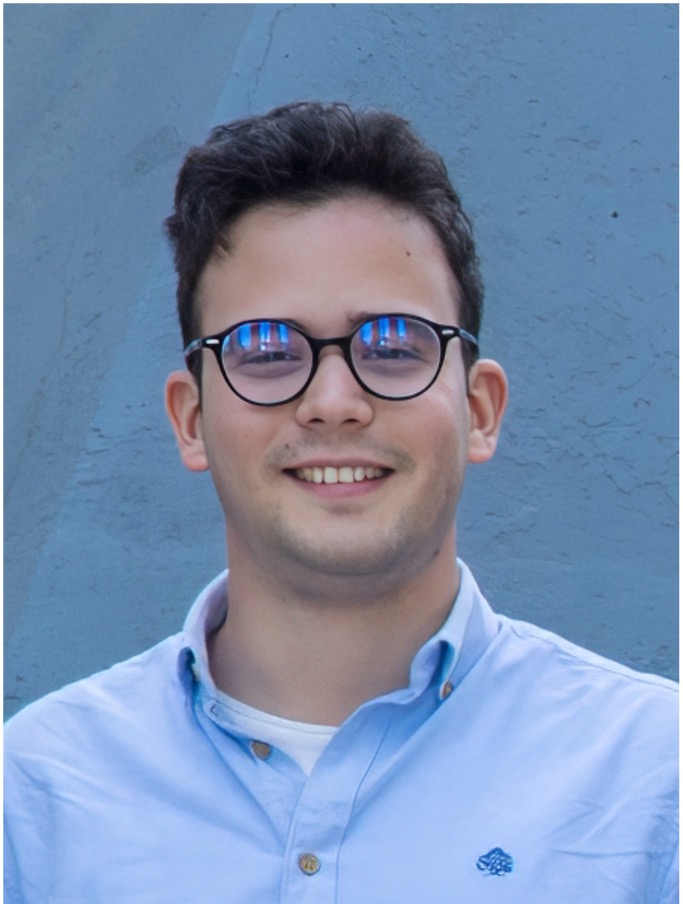
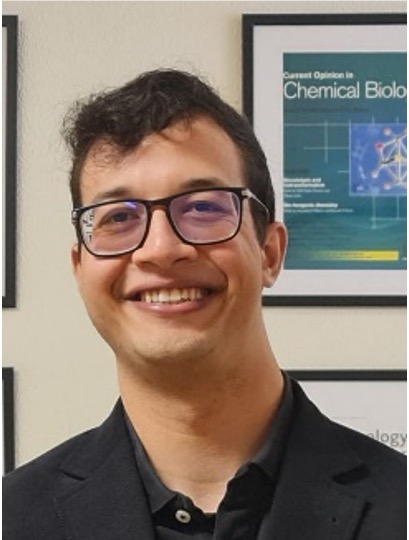
Sandro Amador
Sandro Amador completed his BSc. in Biology – Branch of Cell Biology and Biotechnology, in 2021, at Faculty of Sciences of the University of Lisbon (FCUL), Lisbon, Portugal, and his MSc in Biotechnology, in 2023, at NOVA School of Science and Technology (FCT-NOVA), Caparica, Portugal, under the supervision of Prof. Alexandre Paiva. His thesis was focused on the evaluation of natural deep eutectic systems as anti-biofouling agents.
Currently he works as a researh assistant at Bioinspired Peptide Systems Lab under the supervision of Dr. Ana Pina, in the “COLL-BAT: Collagen-based biobatteries for electronic skin applications” and “Revolutionizing Electronic Skin: Biobatteries Powered by Collagen-based biomaterials” projects. Here he is focused on the development of supramolecular peptide materials for electrochemical applications.
Diogo Antunes
Diogo Antunes is currently pursuing an Integrated Master’s degree in Physics Engineering at NOVA School of Science and Technology (FCT-NOVA) in Caparica, Portugal. He is a research fellow at Bioinspired Peptide Systems Lab currently developing Data Analysis Python Tools to process and analyze large datasets to design peptide sequences likely to exhibit LLPS properties for a better understanding of the molecular rules of phase-separating systems in Nature.
 Bioinspired Peptide Systems Lab